Six roles in order
The report splits into three levels of fit, two roles in each, so you see the near misses as well as the top result.
A Telegram bot from IT Community of Uzbekistan. Twenty pairs of statements, no resume and no personal data, and at the end a report that ranks six roles by how well they fit you, with courses to start from.
Free, anonymous, no registration
Most career tests hand you one word and leave you there. IT Roadmap ends where the work begins.
The report splits into three levels of fit, two roles in each, so you see the near misses as well as the top result.
The details screen explains what each role actually does day to day and why your answers pointed there.
A separate section with where to study, so the search does not turn into another week of scrolling.
Proof that you finished the test, and your results stay saved in the bot if you want to come back to them.
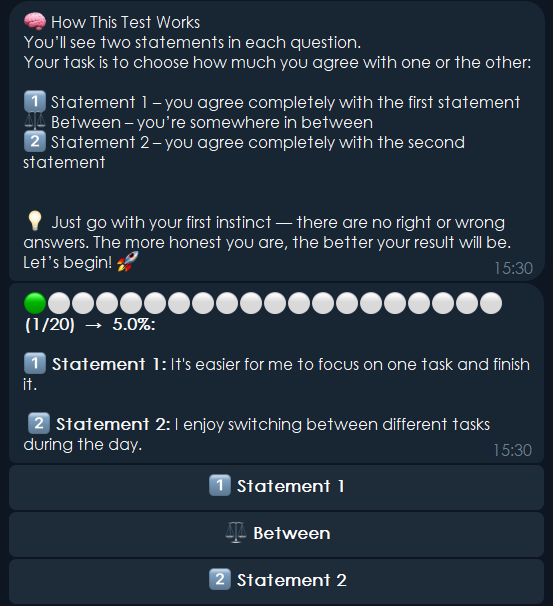
The bot works in pairs of statements: pick the one closer to you, or stay in the middle. Trust the first feeling, there are no right answers here.
It is easier for me to take one task and carry it through to the end.
It is more interesting to switch between different tasks during the day.
I want to build the part a person sees and clicks on.
I want to build the machinery underneath that must never fall over.
I would polish a screen until nobody needs an explanation.
I would break the same screen on purpose to find where it fails.
Three pairs can only point at a mood. The bot asks twenty, weighs the answers against each other and returns six roles sorted into three levels of fit.
Nobody belongs to exactly one role, so the answer arrives as an order rather than a verdict. The second level is often the one worth reading twice.
The two roles your answers point to most consistently. Start looking here.
Close behind, and often a better fit once you know more about the field.
Further from your answers, still open. A weekend project here costs nothing.
IT is not one profession. These are the directions the questions lead to, and each of them has room for very different people.
Everything the user touches: layout, behaviour, speed and the feeling that the product is easy.
The logic underneath: data, services and the part that has to keep standing when traffic arrives.
Apps that live in a pocket, where every megabyte and every second of battery is a design decision.
Making sure the thing works, and that it keeps working after the next release goes out.
Looking at a product the way an attacker would, and closing the door before anyone walks through it.
Deciding what to build and why, turning a vague request into a task the team can actually pick up.
Open the bot in Telegram. No sign up, no email, no phone number.
Two statements at a time. Pick the closer one or stay in the middle, and trust the first feeling.
Six roles sorted into best match, good choice and worth trying, with details behind each one.
Open the courses section, collect the certificate and come back to your saved results whenever you need them.
The bot is a compass, not an oracle. It is worth knowing what it does not promise.
Nothing here measures how smart you are or whether you will make it. It maps preferences, not talent.
People change direction inside IT all the time. Take it again in a year and the order may well be different.
No resume, no contacts, no personal details. The questions are about preferences and nothing else.
Five minutes of your evening for a direction you can start walking tomorrow.